An official website of the United States government. Here's how you know.







Located near the town of Thiaucourt in the Meurthe-et-Moselle department of northeastern France, St. Mihiel American Cemetery is a major World War I site of remembrance. The cemetery extends across 40.5 acres and honors more than 4,100 American service members, most of whom lost their lives during the St. Mihiel Offensive in September 1918.
This American Battle Monuments Commission site is situated within the former St. Mihiel salient, a strategic position that had remained under enemy control before being reduced by American-led forces in 1918. This operation marked one of the first large-scale independent offensives carried out by the American Expeditionary Forces during the war.
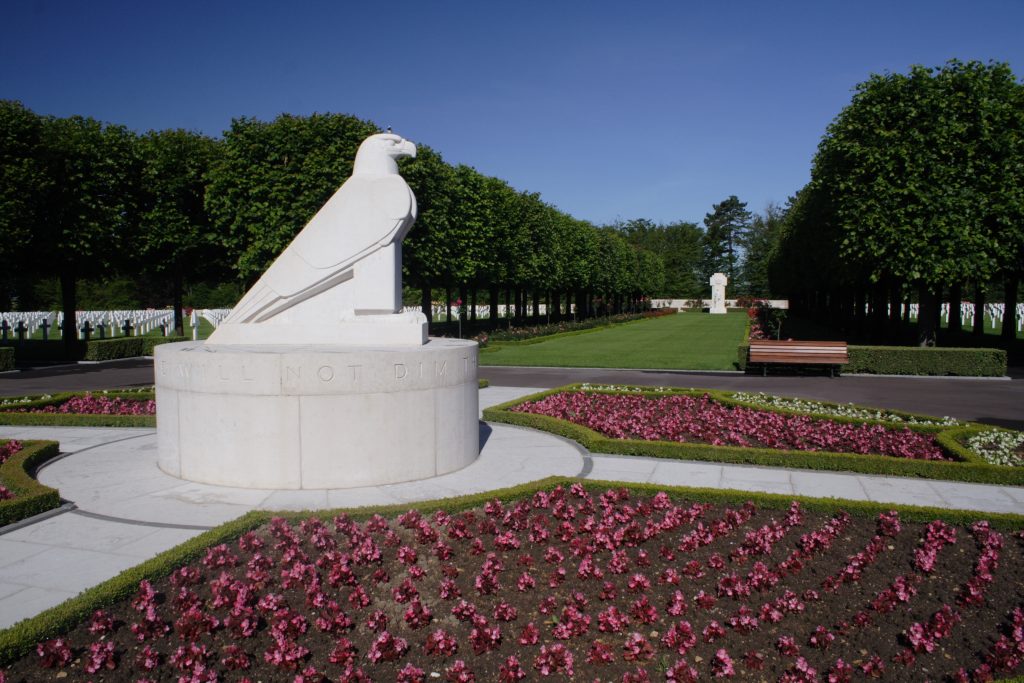
When visiting the cemetery, visitors encounter a carefully designed landscape structured into four burial plots separated by tree-lined paths. At the center stands a large sundial surmounted by an American eagle, one of the most recognizable features of the cemetery. A statue of a World War I soldier and a semi-circular overlook with a sculpted victory vase complete the main axis of the grounds.
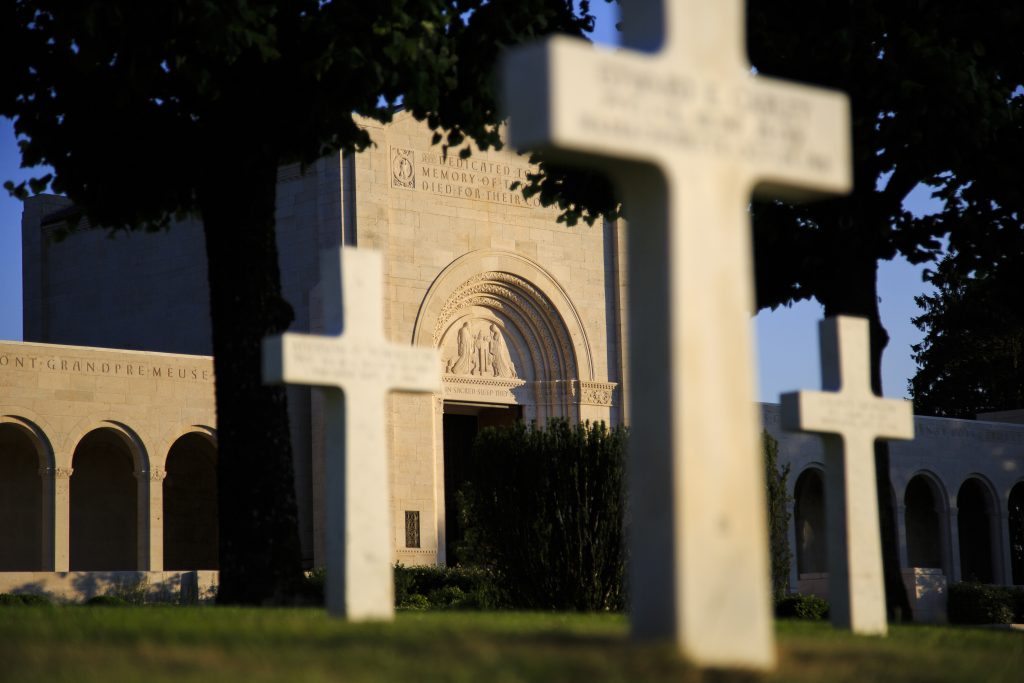
Beyond the burial area, the memorial complex includes a chapel, a peristyle, and a map building. Inside the chapel, a mosaic depicts an angel sheathing a sword, symbolizing peace following conflict. The walls of the memorial bear the names of approximately 300 missing service members, with rosettes marking those who have since been identified.
The cemetery also reflects stories that extend beyond the First World War itself. In 1972, more than 50 years after the conflict, a U.S. soldier, Pvt. Howard A. Heil, a member of the 6th Marine Regiment, 2nd Division, whose remains had been discovered nearby was identified and buried at the site with full military honors, illustrating the continued effort to account for those lost in the war.
The site also witnessed events during the Second World War, when staff and local residents sheltered in the chapel’s crawl spaces during nearby bombardments. During that period, a French gardener, Laurent Jacquat, temporarily assumed responsibilities at the cemetery, reflecting the connection between the site and the surrounding community.
Open to the public free of charge, St. Mihiel American Cemetery offers a place for reflection, remembrance, and historical understanding in a setting that reflects both the scale of the events it commemorates and the continuity of memory over time.
Around Thiaucourt: Exploring Meurthe-et-Moselle
A visit to St. Mihiel American Cemetery also provides the opportunity to explore the surrounding Meurthe-et-Moselle area, where historical landscapes remain closely connected to the events of the First World War.
Located a short distance from the cemetery, the Montsec Monument stands on a prominent hill overlooking the Woëvre plain. The monument commemorates the American forces who fought in the St. Mihiel Offensive and offers a panoramic view of the surrounding terrain, helping visitors better understand the geographical setting of the battlefield.
Nearby, Lake Madine provides a different perspective on the same landscape. The lake offers an open natural environment that contrasts with the commemorative character of the cemetery while remaining part of the same geographic area shaped by the events of 1918.
The St. Mihiel battlefield area itself extends beyond the cemetery and forms an important historical landscape. The terrain of the former salient influenced the course of the offensive, and exploring the surrounding countryside helps visitors place the cemetery within this broader context.
The nearby town of Thiaucourt, located adjacent to the cemetery, serves as a local point of reference and reflects the presence of communities that experienced the war and its aftermath.
More broadly, the Meurthe-et-Moselle landscape is characterized by open fields, wooded areas, and gently rolling terrain. Today, this environment offers a calm and accessible setting while preserving the historical imprint of World War I.

Discover ABMC sites across Lorraine
The Lorraine region is home to an exceptional concentration of American Battle Monuments Commission sites. Within a relatively short distance, visitors can discover no fewer than six American sites of remembrance, including Epinal American Cemetery, Lorraine American Cemetery, Meuse-Argonne American Cemetery, Montfaucon Monument, Montsec Monument and St. Mihiel American Cemetery.
The region is also notable for containing the two largest American military cemeteries in Europe: Meuse-Argonne American Cemetery, the largest American cemetery from World War I regarding the number of service members commemorated, and Lorraine American Cemetery, the largest American cemetery for World War II. Together, these sites offer visitors a unique opportunity to explore American military history across both world wars without having to travel across France. It reinforces the idea that Lorraine itself is a major destination for American remembrance tourism and encourages local and regional visitors to explore multiple ABMC sites during the same trip.
Traveling further: Discover the city of Nancy
The city of Nancy, located about an hour from St. Mihiel American Cemetery, offers visitors the opportunity to discover one of eastern France’s most celebrated cultural destinations. Visitors can stroll through the UNESCO-listed Place Stanislas, explore the city’s historic center, visit the Musée des Beaux-Arts, or enjoy the green spaces of the Parc de la Pépinière.
Nancy is also known for its Art Nouveau heritage, showcased in several buildings and museums across the city. A visit to Nancy provides a natural complement to the historical landscapes of the St. Mihiel area, combining cultural discovery, architecture, and regional cuisine.
A destination connecting history and region
St. Mihiel American Cemetery offers visitors a meaningful experience that connects remembrance with regional discovery. The combination of historical significance, human stories, architecture, and surrounding landscapes makes it a destination where visitors can better understand both World War I and World War II and their lasting impact.